6.05.2009

Keeping a Chin Up While the Butts are Down

I need a reason to celebrate. No fear, here is one: June is Great Outdoors Month. Hop in a kayak, go camping, or tackle some rock climbing because, as President Obama says in his presidental proclamation about the event, natural areas "continue to raise the human spirit in those who experience them." And I don't know about you but my human spirit has been a little saggy as of late.

Today, before 9:00 a.m., I had two different unrepentant ciggarette litterers hang up the phone on me. Before I had a chance to explain why we take butts on the side of the road seriously, they preemptively cut off communication. I know that no one likes to be told that their habits are nasty and antisocial - not to mention illegal - but it is so discouraging that litterbugs are disinterested in learning why we care so much. One man hissed, "You guys have got to be kidding about cigarette butts. You guys get carried away with your little powers that be. Thanks." Click.

I'm not on a power trip and frankly, writing dozens of letters to litterbugs (158 so far this year) is not my idea of fun. I take the time to do it because littering is such a thoughtless action that can have a huge impact on the planet. Even something as little as a cigarette butt has major repurcussions down the line because about 4.5 trillion of them are tossed into the environment every year. What that means is our outdoors sees more than 840,000 tons of litter containing potent carcinogens like benzopyrene and formaldehyde; poisons like arsenic, lead, acetone, toluene, cadmium, and benzene; and hazardous chemicals like butane and ammonia. About one fifth of that will be washed into creeks, streams, rivers and the human water supply. (You can find out more in our cigarette litter brochure here.)

Once you learn all of this, it's hard not be get carried away because cigarette litter - and all litter is so easy to prevent. Sigh. Perhaps if we get enough people to go out and enjoy Great Outdoors Month, more will realize what an enormous problem litter can be.

5.29.2009

Being Lucky in ... Well, You Know

You can find May's eco-article online here. Or you could just read it below.

Ready your hankies ... It's a sappy one.

~~~~~~~~~~~~~~~~~~~~~~~~~~~~~~~~~~~~~
Kentucky Love and Conservation
Becky Haltermon, Boone County Solid Waste Education Coordinator
May 2009

I will freely admit that when I hear “My Old Kentucky Home,” it brings a little tear to my eye.

Driving on the back roads with sun gleaming through the green leaves, I recently had an epiphany: I truly love Kentucky.

This stunning scenery, the glowing skyline of rolling hills, our lush land flush with wildlife – These are the reasons to be a Kentucky conservationist. I’ve spent several summer nights laughing with the locals in Rabbit Hash and innumerable spring mornings exploring our several serene parks. I’ve spotted deer, turtles, snakes, turkeys, and rabbits from backyards in Union. I’ve jumped into chilly ponds on hot August nights. I’ve hiked, canoed, climbed rocks, and picnicked in the woods. I grew up here. I kissed a beau at Big Bone State Park. I celebrated my birthday at Giles-Conrad Park.

And I still find myself awed at the unbelievable diversity, history, and natural wonders found in Boone County and across our state.

I’m sure everyone reading these lines has similar stories to share. Anybody who has spent even a weekend outdoors here knows that clearly, our community is worth conserving. That’s why I recycle. It’s why I opt for the preservation of green space. It’s why I make sure to dispose of household wastes in the most ecological way possible and it’s why no one can convince me that littering is ever a decent idea.

We’re a lucky people who get to live in Kentucky. Join me as I show my pride and, like the trite signs say, help keep Kentucky beautiful.

~~~~~~~~~~~~~~~~~~~~~~~~~~~~~~~~~~~~~

4.23.2009

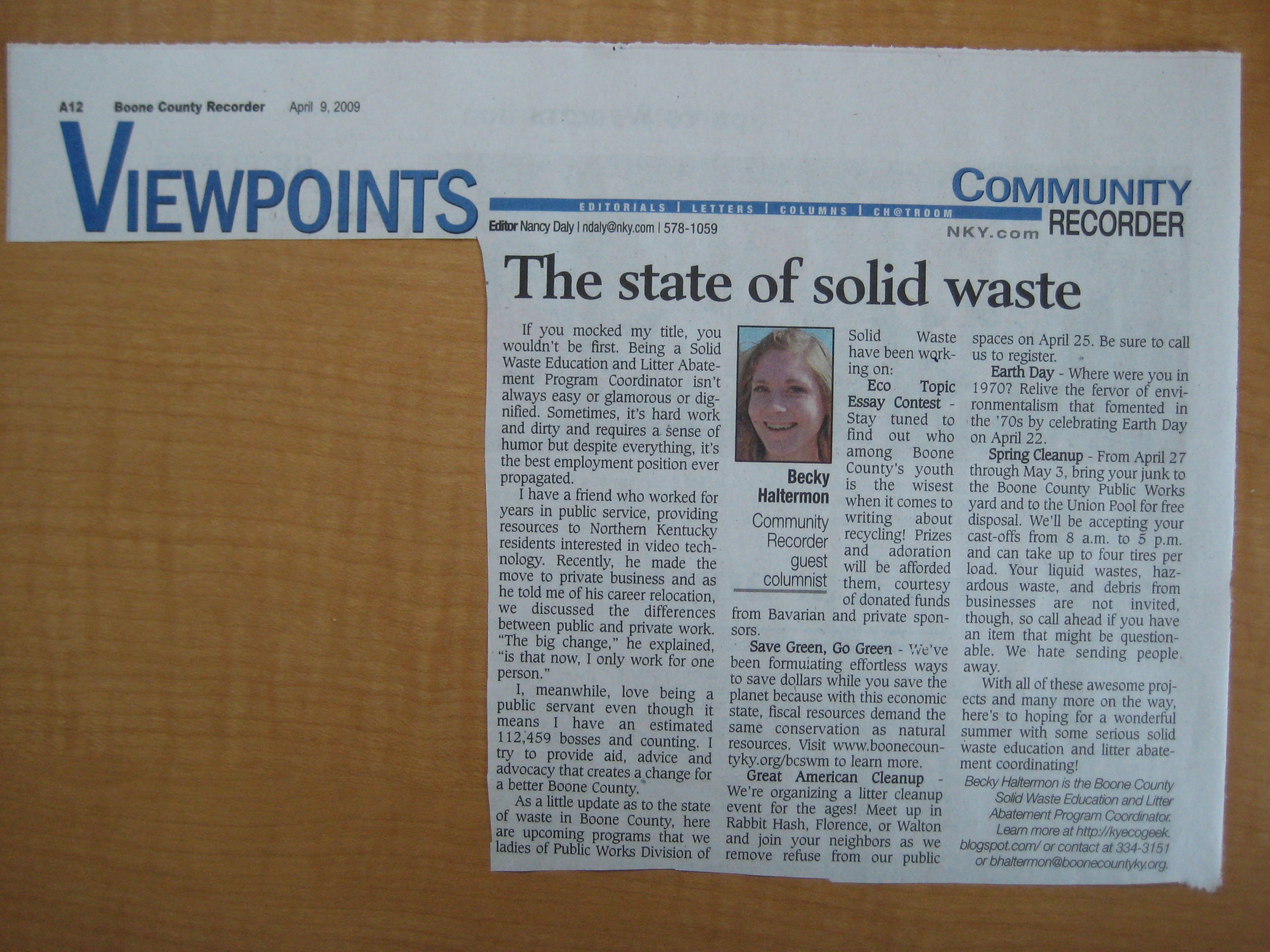
My Bosses Are Tough

April's Eco Article tackles the true meaning of "Litter Abatement Coordinator."

click to make big

4.13.2009

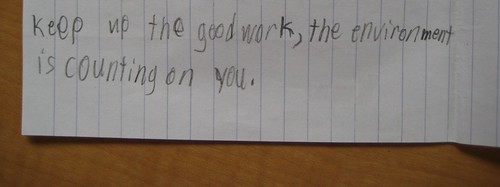
Why I Do What I Do


This is from a letter penned by a sixth grader. With a mandate like that, how could I not keep up the ecological work?

4.01.2009

Propigate Planetary Proteges!

March's Eco-Article is all about our awesome intern, Rosie.

Seriously, she rules.

~~~~~~~~~~~~~~~~~~~~~~~~~~~~~~~~~~~~~~~~~~~
Be An Ecological Mentor
Becky Haltermon, Boone County Solid Waste Education Coordinator
March 2009

We have an intern. It is awesome. It causes me to rewrite the lyrics to the song “Everybody Ought to Have a Maid” from the movie A Funny Thing Happened on the Way to the Forum. Any given afternoon, you can find me sitting in my sunny office, quietly humming, “Everybody ought to have an intern. Everybody ought to have a working teen, an enthusiast who’s laboring for absolutely free!”

It’s not just that our high school serf, Rosie, puts in time without taking a dime and it’s not just that she does all the work that no one else wants to do. What really rules is that Rosie has an excitement for the environment that can only be found in those new to the wonders of solid waste.

“What do you think is better for the planet, having a plastic reusable Christmas tree or a getting a live tree every year?” she’ll ask. “Is it better to take one long hot shower every couple of days or a short one every day?” “Is there such a thing as a ‘green’ funeral?”

There are a million studies noting the positive impact time spent in nature can have on kids. The outdoors can nurture self-discipline (A. Faber Taylor, F.E. Kuo, and W.C. Sullivan, “Views of Nature and Self-Discipline: Evidence from Inner City Children”), improve studies (Anne C. Bell and Janet E. Dyment, "Grounds for Action: Promoting Physical Activity through School Ground Greening in Canada"), and pretty much help the youngest among us grow healthier in almost every way (Stephen R. Kellert, "Nature and Childhood Development"). As far as I can tell, however, there’s very little evidence documenting the undeniable fact that kids can have a colossal positive impact on we naturalists. Rosie makes me rethink old suppositions about what can and can’t be accomplished and her inquires drive me to improve my own preconceptions about new subjects in the ecology field. Basically, her lively ideas are sustaining me until spring when I can ditch mandatory and demoralizing wintertime reports for warm weather litter removing programs and recycling presentations to little kids.

As you may have noticed, it’s sometimes a struggle to stay upbeat in the face of several impending environmental crises but hearing the hope espoused by my anti-pollution protégé helps to keep my optimism afloat.

So, here’s my advice: Grab a kid. Go outside. I promise, neither of you will regret it.

~~~~~~~~~~~~~~~~~~~~~~~~~~~~~~~~~~~~~~~~~~~

Becky Haltermon is the Boone County Solid Waste Education and Litter Abatement Program Coordinator. Learn more at http://www.boonecountyky.org/BCSWM or contact her at 859-334-3151 or bhaltermon@boonecountyky.org.

3.17.2009

Yours, Mine, and Hours

You've surely heard about Earth Hour, right? On March 28, join millions of people across the globe as they turn off their lights to show their support of stoping global climate change. Just flip off the lights from 8:30 to 9:30 p.m. and you'll be part of one of the biggest environmental movements ever to tackle planetary warming. It couldn't be easier.

If you do the Facebook, feel free to sign up for Cincinnati's Earth Hour, planned by Park and Vine.

Last year, I made a big pot of chili by candle light during Earth Hour. This year, I might just be in Columbus. Hm... Do you have any plans for your hour of abstaining from electrical power?

3.03.2009

Fame and Saving Resources


Check out my official byline!

I wrote an article for the American Public Works Association's national magazine, the APWA Reporter. I know, I know, I'll try not forget the little people as I ascend the heights of solid waste superstardom. Heh heh. Okay, I kid.

This article features the bulk of information that we're hoping to roll out as the Save Green Go Green program. More information on that will be coming shortly but in the meantime, here is the entirety of my APWA article. Enjoy!

------------------------------------------------------------------------------------

Making a positive impact in Boone County
Forging partnerships, encouraging creativity and choosing to make small changes

Becky Haltermon
Education and Litter Abatement Coordinator
Boone County Public Works
Division of Solid Waste Management
Burlington, Kentucky

You’ve probably noticed that we are currently riding a sinking economic recession. Conserving taxpayer dollars is a priority for every local entity and certainly Boone County, Kentucky is no exception. Wonderfully, we ladies of Boone County Solid Waste work closely with the Public Works Department, creating a reciprocated relationship that pools resources for maximum public service.

We have teamed up with road crews, the Sign Division, the County Engineer, and every hardworking hand at the Department for almost a decade. While we spend our time fine-tuning environmental programs like recycling, community cleanups, enforcement, and public education and outreach, Boone County Public Works has our backs every step of the way. We are given support, advice, and serious aid from the most hard-working folks in Kentucky.

So in the spirit of superior cooperation, we too share our expertise, giving a little something to the Department and County that has made our programs possible. The conservation of fiscal resources begins with environmental conservation which could save taxpayer dollars while spurring us towards a smaller ecological footprint. Many of these suggestions are easy and could be implemented with little or no cost while immediately improving the bottom line.

Fuel

Remarkably, it is simple to cut outrageous fuel costs: common-sense driving practices are the single most effective method of increasing fleet efficiency.

This means squashing aggressive driving. Stomping on the gas, slamming on the brakes, and revving up all lower gas mileage by five percent in city driving and thirty-three percent on the highway. We need merely increase the calm with which we approach driving government vehicles to save bucks. The same goes for speeding: Vehicles are built to run most efficiently at around fifty-five miles per hour so for every five miles above sixty miles per hour, the vehicle is wasting seven to twenty-three percent more fuel. Obviously, idling an engine will get you the worst gas mileage possible: zero miles per gallon. We ask that our coworkers keep an eye out the amount of time spent idling by being wary of running the engine when no one is in the vehicle and by avoiding long drive-thru lines.

Adding excess weight to a truck can also impacts its efficiency. For every one hundred pounds of extra junk on a vehicle, miles per gallon are reduced by two percent. While it is often the norm that County trucks haul heavy stuff, it couldn’t hurt to investigate each vehicle to see if its load can be reduced.

Operating the A/C can also affect fuel economy. For city driving, using the A/C can lower a vehicle’s efficiency by about a mile per gallon. At speeds of fifty-five mile per hour and higher, however, open windows create drag and can actually reduce fuel economy even more than the A/C. Therefore, we can maintain optimum fuel efficiency by using the A/C while highway driving and rolling down the windows when in stop and go traffic.

Other ideas to keep in mind include using the cruise control when covering level land because it keeps speeds constant, using the highest gears possible to lower the vehicle’s engine speed, carpooling when workable, and combining trips.

Sources: The US government’s website on fuel economy, www.fueleconomy.gov; www.cartalk.com; www.edmunds.com; www.npr.org; www.doe.gov; www.epa.gov

Offices

Office spaces are often rife with waste but minute changes can seriously cut costs. For example, by simply changing the margins of Word documents, agencies can cut the amount of paper consumed. The Penn State Green Destiny Council estimated that by changing paper margins to .75” on all sides, there is an estimated 4.75% reduction in paper use. Similarly, paper consumption can be reduced by using both sides of the sheet as some companies have seen a 10% reduction in paper use by setting their copier defaults to print on both sides instead of one. For serious print reduction, move files to a solely electronically-based format and increase employee access to computers. Everyone appreciates fewer printed memos. Also, posting instructions near copiers diminishes paper waste due to mistakes made when copying and reducing the size of a document when copying can turn two pages into one. For a final paper-saving tip, collect paper that has a blank side and then cut and staple it into note pads. In five minutes, employees can save paper from being wasted and save taxpayers a bit of money by not buying new notepads.

Other ideas for office efficiency include repairing, instead of replacing, office furniture and equipment, sharing old office supplies like plastic binders, file holders, clips, etc., keeping reusable kitchen supplies like silverware and ceramic mugs, buying bulk creamer and sugar, taking advantage of water coolers instead of buying bottled water, and cutting water waste by fixing leaky faucets and toilets as fast as possible.

Sources: http://www.changethemargins.com/; Cutting Costs and Preventing Waste in NYC Office Buildings and Institutions: Three Case Studies. http://www.p2pays.org/ref%5C03/02229.pdf; SFU Sustainable Campus Coalition’s Green Practices Guide: Green Practices for the Home and Office, http://www.sfu.ca/~sustain/pdf/green_practices_guide.pdf; Scottish Environment Protection Agency, Greening SEPA: Going Green, http://www.sepa.org.uk/green/guidance.htm

Energy

Reducing the energy bill is a key component of fiscal responsibility. Thirty percent of all energy use in the US goes towards heating and cooling buildings so that thermostat downstairs is a major player in increasing monetary supplies and decreasing pollution. In the winter, open blinds to let the sun inside and warm offices. In the summer, drawn blinds can help cool these rooms. This uses a free natural resource – the sun – as a replacement for an expensive resource – coal-fueled electricity. Keep doors and windows shut to keep in the warm/cool air and avoid heating or cooling to the extreme. Easy.

Lighting a building can suck up electricity so we offer natural light as the best option whenever it is possible. Also, task-specific lighting uses less energy because you end up brightening only the corners of a building that need it. Naturally, it is best to turn out the lights whenever they’re not needed.

Computers are another energy vulture. Allowing a computer to go into standby mode can use as much as 30% the machine’s normal energy expenditure so turning it off is smarter than letting it settle into standby. Just turning off a computer monitor when going to lunch saves electricity as monitors use 60% of the energy devoured by computers. For other energy savings, investigate purchasing Energy Star equipment. These are machines that have been certified by the EPA as preferable because of decreased energy consumption.

Here are some other facts to keep in mind: Laptops use up to 90% less energy than the standard desktop, ink-jet printers use up to 90% less energy than laser printers, Flat screen LCDs use approximately 1/3 the energy required for a CRT monitor, and taking the stairs uses no electricity and costs no money, making it a far better choice than taking the elevator.

Sources: SFU Sustainable Campus Coalition’s Green Practices Guide: Green Practices for the Home and Office, http://www.sfu.ca/~sustain/pdf/green_practices_guide.pdf; Scottish Environment Protection Agency, Greening SEPA: Going Green, http://www.sepa.org.uk/green/guidance.htm

So sure, lean times have come upon many of us in local government. But by forging partnerships, encouraging creativity, choosing to make small changes, and opting for conservation, we can all have a positive impact on our agency’s finances and the environment. I know that we here in Boone County will be banding together to do just that.

------------------------------------------------------------------------------------

2.24.2009

A Potpurri of Eco Ideas

I've been so busy getting our annual report together that I have been unable to update this, my faithful blog. Here are some of the most fun ideas that have flown by my desk in the past few weeks:

Sanitation District No. 1 has rolled out the rainbarrels. You can conserve the water runoff from your roof to water your flowers and at the same time, reduce your water bill, keep water away from your building foundation, and do your part to cut down on water pollution and flooding. It sounds all-around wonderful.
~~~

Have you heard of Ecofont? Those crafty Dutch have developed a font that uses 20% less ink but looks almost identical to your standard Ariel. The secret? Little empty dots in the letters that are unnoticable at your standard typeface size. See if you can tell which of the quotes below were printed with Ecofont:

click to make big

Give up? In the top quote, the second was typed with ecofont and in the bottom quote, the first was the environmental verbiage.


It's hard to tell a difference at all...


...Even up-close.

click to make big
But when you look at it on the computer screen, especially in a large size, it is pretty obvious.
~~~

Finally, on a (somewhat?) lighter note, a short film on the horrendous karma that can result from environmental indifference can be found here: It All Comes Back to You

2.10.2009

I know I feel warm.

I don't often write about global warming but I decided to give it a go after listening to this story on NPR. I was listening to it while getting ready for work and it scared the boogers out of me.

Below you'll find the my eco-article concerning climate change followed by the websites of the news stories I reference. Let's discuss!

~~~~~~~~~~~~~~~~~~~~~~~~~~~~~~~~~~~~~~~~~~~~~~~~~~~~~

Ideas Driving Climate Change Salvation
Becky Haltermon, Boone County Solid Waste Education Coordinator
February 2009

I just got back from Columbus.

It’s a solid two hour drive from the Columbus suburb my boyfriend now calls home to my desk here in Burlington and it is a drive I imagine I’ll making quite often in the coming months. Like I said, my boyfriend now officially resides in Columbus. Talk about an inconvenient truth.

Two hours is a lot of time and if you’ve ever piloted a vehicle up I-71, you know that there isn’t a whole lot of landscape to divert your mind while on the road. Perhaps that’s why, after wondering why I drive my loved ones to relocate to remote Ohio towns, I began to ponder the inexorable evil of global warming.

Climate change is not a topic I broach lightly. A Pew Research Center poll in January found that global warming ranks dead last in a list of priorities people want our new president to deal with. We want the leader of the free world to wrangle tax cuts and tackle the deficit before he tries to save the planet and I understand that. It’s hard to worry about the plight of polar bears when your mortgage lender is breathing down your neck.

At the same time, we’re facing a climactic catastrophe that could make the current recession pale by comparison. Under the upbeat headline, “Climate Change is Coming No Matter What We Do,” Steve Graham reports that according to Heinz Center senior scholar Dennis Ojima, Ph.D, “The latest data shows actual carbon emissions exceeding the most extreme scenarios envisioned by the Intergovernmental Panel on Climate Change, the leading world agency on global warming.”

Robert Correll, another Heinz Center bearer of unhappy news told NPR that even if the US and other leading greenhouse gas emitters meet their extremely ambitious goals for pollution reduction, it won’t solve our problems. “Absolutely not so,” Correll intones.

The report goes on to say that to stave off major planetary decimation, we’d need about a five percent reduction in carbon emissions from industrialized countries and a stabilization of the CO2 pollution rates for the rest of the world. Just in case you think that that sounds doable, Correll wants you to know that, “Five percent per year is huge!”

This reduction could cost tens of trillions of dollars over time and would require the cooperation of all of the industrialized world. “This is sort of a wake-up call,” Correll explains. No kidding.

Lest you suggest that I give in to a doom and gloom scenario, I confess that I’m not building an ark just yet. One reason is because our nation’s new energy secretary, Stephen Chu, is also a little upbeat. Last year, he told NPR that he is, “actually optimistic,” about reducing energy consumption in the US. “With new tech coming online,” he says, “and things that one hopes to develop, the goal is not to say: 'OK, everybody uses less energy, don't heat your homes, don't light your homes, don't use AC.'” Don’t drive to Columbus. “That is not the goal. The goal is to have a standard of living that is carbon neutral and works well with the world. And I think it's possible.”

Dan Sarewitz of the Consortium for Science Policy and Outcomes based at Arizona State University also refuses to throw in the towel. "The idea,” he told NPR, “is to take the political heat off of climate change and instead move this into the realm of policy wonkdom where many many small decisions made across many agencies, many types of policies, many domains, set the conditions for moving in the right direction without demanding that people accept that this is the most important problem in the world."

So the next time I hop in my small silver sedan on an extended trek to see my man, maybe I could try to see if those gray clouds crowding the sky above the interstate have a silver lining.

~~~~~~~~~~~~~~~~~~~~~~~~~~~~~~~~~~~~~~~~~~~~~~~~~~~~~


That quote from Secretary of Energy Stehpen Chu was culled from this NPR article.

Climate Change is Coming No Matter What We Do can be found here.

This is the article that features Robert Correll and Dan Sarewitz.

Here is that Pew Research Center poll.

You can learn more about the Heinz Center here.

Whew.

1.28.2009

Overlapping Areas of Geekery

You may have noticed that my latest eco-article mentions televisions switch to digital next month. Okay, on the face of it, this technological event is not very environmental at all. I understand that. But again and again I see people tossing their perfectly usable TV because they've upgraded to a fancy flat-screen out of the misguided notion that after February 17, their old sets will be obsolete.

THIS IS NOT TRUE.

If you're like my boyfriend, you may use this digital switchover as an excuse to sneak out to Best Buy and drool over plasma screens as big as a kitchen table. But if you're into ecology like me, you can keep your old TV. Snag a fancy little converter box and marvel at the wide array of public television stations now available to you.

Of course, if you have cable or a dish, all this is moot. All you need do is continue enjoying the 928,928 channels available to you.

At any rate, it looks like the digital switchover might just be postponed until June. Learn more in this NPR story. But that delay doesn't really matter to you, my dedicated reader, because you are now armed with the facts. Find our more of the official line on DTV here.

So, in addition to the nerdy interests I harbor for environmental awareness and public TV and radio, I am also an amateur radio operator. Oh, yes. I'm a ham. Hawaii has already switched to a digital signal and enlisted the help of local amateur radio operators to aid in the transition and below, I've transcribed a few of the lessons learned by John, K1ER, in Honolulu.

Having worked with the FCC during the FIRST conversion to DTV (Hawaii), here are a few background things you SHOULD KNOW since they'll help you answer questions from the other 49 states.
  • The conversion was mandated by CONGRESS to free up the present analog TV spectrum for OTHER USERS.
  • The conversion was DIRECTED by CONGRESS.
  • The $40 coupon program was run by the former Bureau of Standards now NIST, the National Institute of Standards and Technology.
  • The FCC was ordered to deal with the public and broadcasters during the conversion.
  • For those who can receive it THE DIGITAL PICTURE IS BETTER.
  •  There is NO IMPACT on people using Satellite TV or CABLE.
  • The $40 coupon is ONLY issued ONE TIME to any address (Becky: In our area, you can have two coupons per address) AND they EXPIRE shortly after issue. MANY!!!!! people ordered the coupon and did not CASH IT! Resulting in the FUNDS for COUPONs being tied up like "outstanding checks" so the NIST STOPPED issuing COUPONS. As the COUPONS expire unused, funds are being applied to NEW COUPONS but the DELAY is over 8 weeks!
The FCC is taking the heat from viewers for problems NOT under their control and NOT caused by the FCC.

I love the expressive way John writes.

If you find yourself intrigued by the idea of amateur radio, you can find our more here. (I know that using Wikipedia isn't the safest bet but I really liked the simple, one-line intro into the world of dorky radio.)